Labels

A post on James Trotta’s blog (Sept 21) caught my eye the other day. In it he tells the story of how, in middle school, he’d tried to learn the names of colours in Spanish by labelling the colours on book covers – and then got accused of cheating by his Spanish teacher who saw the word for yellow on his exercise book while he was doing a test.

So sad – labelling is a great learning strategy which allows vocabulary to be assimilated effortlessly. A couple of years ago the daughter of a friend of mine did a crash course in Spanish prior to going to Mexico to work as a volunteer during her gap year. And when I visited them one weekend, everything in the house was labelled with its Spanish name on a yellow Post-it note.

Now I don’t speak a word of Spanish, but even now two years later, I can still remember a few of the Spanish words that I saw in the house that weekend – toilet paper seems to have stuck most firmly, for some reason. I hadn’t tried to learn them at all, they were just there. But they’ve stuck.

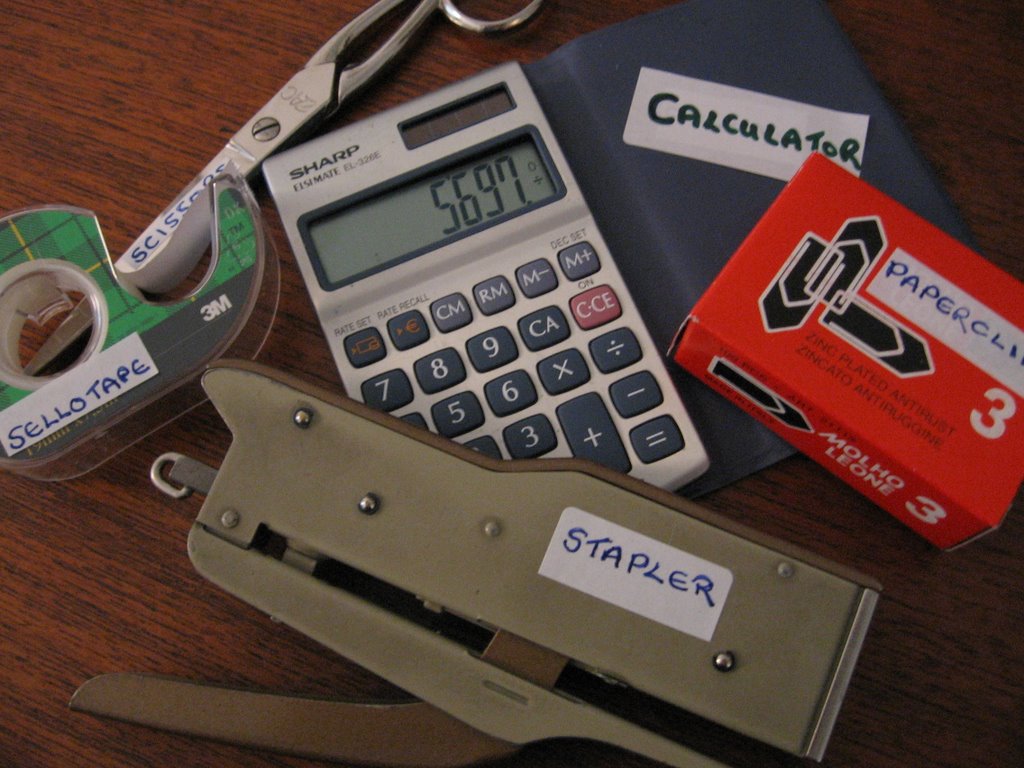
Not all of our students intend to live in an English speaking country, and therefore some household vocabulary may be irrelevant to them. But even business English students need to know the names of certain everyday objects. When staying in hotels on business trips they may need to ask for towels or soap – or yes, toilet paper. And if they are visiting an overseas branch of their company, they may well need to borrow office equipment – scissors, a stapler, paperclips and so on. By labelling these objects in their own offices, they are subconsciously consolidating their knowledge of the word every time they use them – and are much more likely to remember them when they need them.

A Game for Younger Learners

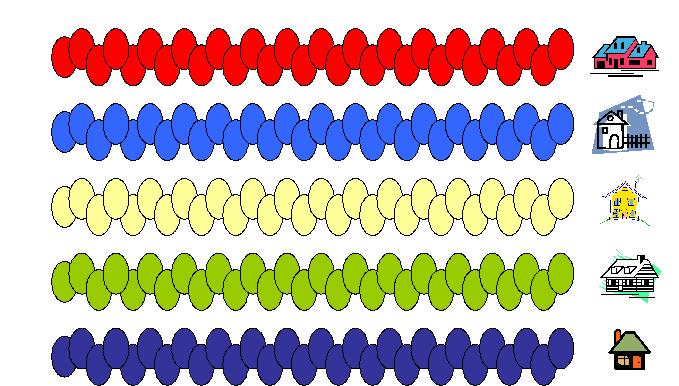
This is a game for younger learners which aims to consolidate the numbers 1-6 and the colours. For each group of children you will need : two dice – one with numbers and the other with colours; a counter for each child; and a playing board. The playing board should have the same colours as those on the dice and can be made easily using Word and clipart. If you don’t have a colour printer, you’ll need to leave the circles blank and then colour them by hand. The number of circles you use will depend on the age and attention span of the children. There are also various ways the game can be played – choose depending on which you think your learners would take to best.

Version One :The players start with their counters on the circle furthest from the house. Each child in turn throws the colour dice and says the colour. If it’s the same as the colour of their “path”, they throw the number dice and move their counter forward the same number of circles. The first one to reach their house is the winner.

Version Two : The first player throws the dice, but this time the player on his/her left calls the colour and the number. If either of those two players has the correct colour, s/he moves her counter the appropriate number of places. This speeds the game up a bit, as there’s a one in three chance of someone moving, instead of only one in six.

Version Three : In each group one child is the dicemaster but does not play. The dicemaster throws the dice and calls the colour and number that come up. The player with that colour moves their counter forward the appropriate number of circles. At the end, the winner becomes the dicemaster, and the old dicemaster joins the game. This makes the game much faster, as someone moves on each throw.

The problem with any game like this is that it’s quite possible to play without saying anything – which defeats the object of the activity in an EFL classroom. One way of getting round this with Version Three is if the dicemaster throws the dice behind a barrier (such as a large book) which prevents the group from seeing the result – that way they have to listen to what s/he says. Another possibility, is if the teacher throws the dice and calls the colour and numbers to the whole class. Obviously, in this case there will be a winner in each group at the same moment. This only consolidates the children’s receptive knowledge of the language, but is sometimes a good way of introducing Version Three and making sure the children understand the game before they continue playing in groups.


Further Reading ...

On Contractions (Part Two)

In yesterday’s post, I suggested you try and analyse the rules behind the use of contracted forms of the verb BE. Here are the rules that describe the examples included in the eight conversations. The numbers indicate some of the conversations that included an example of each rule. Unfortunately, yesterday I wasn’t able to persuade Blogger to let me use numbers instead of bullet points. Goodness knows why – it’s a site with a mind of its own. But it should be easy enough to work out which sentences I'm referring to.
  • Contract am/is/are with pronouns I’m He’s They’re etc in affirmative and negative sentences. (1B, 2A, 2B)
  • Contract is/are with not in negative sentences : isn’t aren’t (2B, 4A)
  • Contract is with nouns: David’s in Italy; My car’s over there. (2B, 6B2)
  • Contract is with question words before nouns : Where’s David? What’s the time? How’s your wife? (1A) But when BE is the main verb, don’t use the contraction if the following word is a pronoun (8B, 8A2) : RIGHT : Where’s John? WRONG : Where’s he? (BE = main verb) RIGHT: Where is he? RIGHT: Where’s he going? (BE = auxiliary verb)
  • In writing, are is not usually contracted with nouns in the written form (4B): WRONG : My friends’re from Italy RIGHT : My friends are from Italy or with question words (4A, 6A) : UNUSUAL : How’re you? Why’re you here? RIGHT : How are you? Why are you here? However, in the spoken form these words are usually pronounced as a contraction and informal writing will sometimes follow suit.
  • Similarly is or are are not usually contracted in writing with words which end with the same letters (5, 3A) : UNUSUAL : This’s my wife. RIGHT : This is my wife. UNUSUAL : Here’re your keys RIGHT : Here are your keys. But again, you may see it in very informal texts.
  • NEVER use contractions when BE is the last word in the clause, and therefore stressed. For instance :
    a) in indirect or reported speech : RIGHT : Can you tell me what the time is? WRONG: Can you tell me what the time’s? b) in short form affirmative answers (3B,7B) : A : Are you ready? B : Yes I am. WRONG : Yes, I’m / A : Is John here? B : Yes, he is. WRONG : Yes, he’s. But you can use them in short form negative answers, as BE is not the final word : A : Are you ready? B : No, I’m not. / A : Is John here? B : No, he’s not.

So where does this leave us as far as teaching is concerned? Firstly, if you are a non-native teacher, you obviously need to know the rules yourself in order to use the language correctly when you’re talking to your students. Secondly, both native and non-native teachers need to decide what to do about the “grey areas” like where’re and who’re. Are they "incorrect" even though sometimes used? Should they be avoided at beginner level but introduced later? And finally, you need to decide if and when you are going to explain the rules to your students. With beginners, they can be pointed out when examples come up in the coursebook, or when the learners make mistakes in using them. With more advanced students who are continuing to have problems with the area, an activity like yesterday’s post can be used – give the students some example sentences, ask them to decide from their previous knowledge which examples can and can’t be contracted, and after confirming or correcting their answers ask them to formulate the rules. This type of exercise helps develop an active approach to learning, encouraging the students to notice how the language works for themselves rather than depending constantly on the teacher.

What do you think? Do you find rules like this are useful, or is this just an area that has to be acquired through gradual exposure? And where do you stand on the where're what're question?

On Contractions (Part One)

The Verb BE seems simple – it’s usually more or less the first thing we teach, to students of every age. But when it comes to the contracted forms, it’s actually very complex. Have a look at these conversations. Decide where it is and isn’t possible to use a contracted form (the answers are given below, so if you're not a native speaker you can check). But why? What are the rules? Use the examples to try and work them out for yourself before you look at the discussion in tomorrow's post.

The examples :


  • A : Who is that woman? B : I am not sure, but I think it is the new Marketing Manager.

  • A : Come on! We are late. B : No, we are not. It is only 2.30. The meeting is not until 3.15.

  • A : Is Jane here? There are some messages for her. B : Yes, she is. She is in the office.

  • A : Where are the keys? They are not in my bag. B : The car keys are in the kitchen and the house keys are on the table near the door.

  • A : Come on! The bus is here!

  • A : Hello Chris. How are you? B : I am fine thanks. A : And how are your parents? B : My mother is fine, but my father is not very well.

  • A : What are those flowers? Are they geraniums? B : Yes, they are.

  • A : Do you know where John is? B : No? Where is he? A : He is in Pat’s office. What is he doing there?

  • The answers (contracted forms are used whenever it is possible) :


    1. A : Who’s that woman? B : I’m not sure, but I think it’s the new Marketing Manager.

    2. A : Come on! We’re late. B : No, we’re not (or : we aren’t). It’s only 2.30. The meeting’s not (or: the meeting isn’t) until 3.15.

    3. A : Is Jane here? There are some messages for her. B : Yes, she is. She’s in the office.

    4. A : Where are the keys? They’re not (or : They aren’t) in my bag. B : The car keys are in the kitchen and the house keys are on the table near the door.

    5. A : Come on! The bus is here!

    6. A : Hello Chris. How are you? B : I’m fine thanks. A : And how are your parents? B : My mother’s fine, but my father’s not (or : my father isn’t) very well.

    7. A : What are those flowers? Are they geraniums? B : Yes, they are.

    8. A Do you know where John is ? B : No? Where is he? A : He's in Pat's office. What's he doing there?


    Vocabulary Cards


    This is a technique I’ve used with adult beginners in monolingual classes who are following a non-intensive course meeting once a week. It aims to help them assimilate the new vocabulary taught in the lessons.

    If you have a large class, divide them into groups of about five or six. Give each member of each group an envelope with the names of the people in the group listed on it. The names must always be listed in the same order.

    Tell each student that, for homework, they should choose ten words or expressions from the lesson just taught, or the unit in their course books, which they want to remember. Ask them to get a piece of thin card, to cut it into small squares (3cm x 3cm is about right) and to write on one side of the square one of the words or expressions. On the other side they should either draw a picture of the object or write the translation of the word. The photo shows some examples of the “meaning” side – on the back would be written a flower, car park, It’s three o’clock, thirty, play football, a table.


    Ask them to keep the cards, in the envelope, in their bags or pockets all week. At least twice a day they should take them out and look at them, looking first at the side with the picture/translation and trying to remember the English before checking the answer. This shouldn’t take more than two minutes, and can be done at moments when they have nothing else to do – for example when they’re waiting for a bus.

    The next week they should bring the envelope, with the cards, to the lesson and pass it to the next person on the list. (The last person passes it to the first). They now have an envelope with ten cards, not necessarily the same as the ones they chose the previous week, to which they should add ten more cards with words from this week’s lesson. They now have twenty words to study during the week.

    In the following weeks the same thing happens. They pass on the envelope to the next person on the list, and add ten more words. After five weeks (presuming groups of five) each envelope will contain fifty cards, and will return to the person who put in the first ten words. That week, and every week from then on, each person takes out the ten words she or he had previously put in, before replacing them with another ten.

    In this way, students are constantly recycling words from previous lessons, and because they see the words that other people have chosen, get maximum exposure for the minimum of effort – they only have to produce ten cards per week, but are constantly working with fifty. The activity also helps to increase group cohesion, and to give students a sense of shared responsibility for the progress of the group.

    The activity has provoked generally positive feedback from the students who’ve used it. “Useful” “easy to do” and “interesting” are some of the comments. Some students have pointed out, however, that it can be counter-productive if other students are inaccurate in what they write on the cards – writing the wrong meaning or, more usually, making spelling mistakes. This can be avoided if, as the students come into class, they lay out on the table the cards they have made. The teacher can then quickly check them whilst the others in the group are still arriving and settling down, and the students can redo any with errors. This uses the first few minutes of the lesson productively, even if there are latecomers, and resolves the problem.