Showing posts with label Teaching Writing. Show all posts

A Genre Approach to Teaching Writing

This article focuses on a genre approach to teaching writing and asks...

a) what are the typical activities involved in this approach?

b) what are the reasons for and against taking a genre approach to teaching writing.


A. Typical activities (Underlined)

1. Activities to sensitise the Ls to, and practice the features of the genre. This is less confusing for learners if only one feature of the text is focused on at once – eg grouping of related information in paragraphs (for expository texts) rather than random order of points; the use of direct speech (for story writing); avoidance of informal language (for business reports) etc. This means several features may be presented and practised (see also points 2 and 3 below) before the ls are asked to write a full text.

Examples of typical presentation activities include:

2. Presentation of two versions of the same text – one well written and illustrating the feature to be “noticed” the other not. Ls decide which they prefer and why. Eg if the genre was story writing (many exams give the Ls  the option of writing a story  as part of the written paper), the Ls might read two versions of the same story, one using adjectives and adverbs of manner to help the reader visualise the scene and the other not.

3. Learners can be given several model texts and asked to compare them for similarities, thus increasing their awareness of the fact that specific genres do follow conventions that all writers adhere to. Eg: If the feature was organisation of information – eg in a university application cover letter which many EAP learners might need to write– learners could be given several model texts and asked to identify the topics covered, the amount of space/number of paragraphs and lines devoted to each, and the order in which they were included.

4. If the feature is linguistic  - eg the use of ellipsis in customer reviews on websites such as “Trip Advisor” (relevant to all general purpose learners who might want to write such reviews after a holiday), Ls can be given authentic samples and asked to “notice” the feature – here by identifying  what words are “missing” from each sentence.

5. Matching activities : Similarly, if the feature was the use of connective expressions to indicate the semantic relationships between propositions in a text  (useful for Ls needing to write expository essays in an exam) the Ls could first be given two (or three) lists of  propositions – the second  and third list in random order in relation to the first. They match them and decide the relationship (eg “Studying online has several advantages” matches with “It saves time”, which in turn matches with “You don’t have to leave home to attend lessons”) They match the propositions and decide the relationships between them (here proposition 1 – example – cause). They then read the text and note how these relationships are marked linguistically – eg  : “Studying online has several advantages. First of all, it saves time as you don’t have to leave home to attend lessons.”

Activities to give further receptive exposure to the individual features. Eg :

6. Gapped texts : If the feature that has been presented was the use of topic sentences in expository texts, Ls might be given a well-structured text with the topic sentences missing from the paragraphs. They could then match a list of “jumbled” topic sentences with the paragraph they relate to.

7. Sentence reconstruction : If ellipsis is being focused on, Ls can be given a text with the symbol ^ used where a word has been ellipted – eg in a review of a hotel :” ^ Didn’t sleep well - ^^ too much noise from the traffic outside. But ^ breakfast ^ excellent.”  They then “notice” which words have been ellipted.

8. Scrambled sentence/paragraph activities : Eg- If ls are focusing on the organisation of information, a list of scrambled sentences can be provided which they then organise into logical order.

 Activities to give practice of the individual features include.

9. Text Completion : As 6 above, but this time the Ls invent their own topic sentences for the paragraphs.

10. Text Adaptation: As a follow up to 4 above, they can be given a text with all the words included and cross out those which could be ellipted.

Freer writing practice activities then allow the Ls to incorporate all the features they have focused on into a complete example of the genre.

11. Early writing tasks may be scaffolded by the provision of activities often used in product-type approaches such as being given and following an outline plan for the essay

12. At this stage elements of a process approach may also be incorporated – eg Ls can be asked to brainstorm ideas for an expository essay and then group them before actually writing the text and incorporating the genre features they have focused on.

13. Peer evaluation can then be done, using a checklist – Ls evaluate each other’s texts to see whether and to what extent the features have been incorporated (and to learn from examples which are more effective than their own).


B. Reasons for the approach

14. Genre conventions differ from culture to culture. For example, Italian written texts favour much longer sentences than are considered acceptable in English, will avoid the type of hedging common in academic style, and will discuss many more background details, often leaving the main point implied rather than directly stated. An Italian who transfers this style to writing in English is liable to be criticised as “not knowing how to write” by eg an academic supervisor or, in a work situation, their boss. This may lead to them being penalised – eg achieving a low mark or being passed over for promotion. The genre approach ensures the Ls have a clear idea of what is expected and how to produce it.

15. Where the features differ radically between cultures, it provides a systematic “feature by feature” approach which allows Ls to concentrate on and master one feature at a time. As part A above suggests it is a PPP approach to writing which ensures that learners are not overloaded or given full writing tasks until they are ready for them.

16. As part A suggests, the approach generally incorporates activities based on a constructivist approach - discovery learning, peer-evaluation etc. This will a) mean that understanding tends to be processed at a deeper cognitive level than if Ls are simply “told what to do” and understanding and retention are more likely; b) contribute to the development of learning autonomy; c) engage the learners more fully with the lesson, increasing enjoyment and motivation.

17. It is an approach which can be adapted to cultural needs. The “constructivist” aspect of the approach may be alien to the educational cultures of some countries (eg Vietnam) where the T. is expected to be the “knower” and to “tell” the Ls what they need to learn, and could therefore create student dissatisfaction with the course. However,  in this case it would be easy to revert to a more traditional product based approach  (presentation of a model – explanation of features by the T  – reproduction of features – T. evaluation) without abandoning the focus on genre features.


C. Reasons against the approach

18. It has been argued that this type of “imposition” of specific genre features suggests a “colonial” approach where “our way is right and yours wrong”. It has therefore sometimes been rejected for political reasons.


An Example Lesson...

For an example of materials teaching learners to write customer reviews, and using a genre approach, see here. This genre has also been analysed in the Language Matters section - see the post on Customer Reviews. Looking at it first will help you understand the rationale behind the materials.


An Eclectic Approach to Teaching Writing


This article, originally used on our Delta Module One course, focuses on an eclectic approach to teaching writing.  It... 

a) describes the different approaches generally used when teaching writing, their advantages and disadvantages. 

b) discusses how these may be combined to exploit the advantages and avoid the disadvantages of each.


a) Approaches to writing

There are three common approaches to teaching writing:

1. A traditional “product” approach: This was part of structural approaches to teaching English and common before the 1970s. Writing was seen merely as a way of providing further practice of whatever language was currently being taught. So if eg the Ls had been studying prepositions of place and lexical items in the field, they might be asked first to read a model text describing a room in a house, and then to write a similar description of a room in their house producing eg There’s a single bed in my bedroom and next to it there’s a bedside table. On the bedside table there’s a lamp… etc.  The text would be marked and graded by the teacher.

Advantage: This was a systematic approach which did not overload the learners at any point – first the linguistic items were presented and practised, then recognised again in the model, before they had to be produced. 

Disadvantages: i) It is entirely T. led.  ii) It left out of account the fact that when writing we always have an intended purpose (to persuade, entertain, inform etc) and an intended reader. The two factors combined will affect eg the choice of information included, the style of writing etc. Here there was no realistic purpose other than to use the TL accurately, and no presumed reader other than the teacher.

2. A process approach: In the 1970s, people started to argue that writing was a matter of going through various processes – brainstorming content; selecting and rejecting content; organising content; drafting; revising etc as well as “just” formulating the language needed – and that these processes needed to be worked on in the classroom.

Advantages: i) Ls became more aware of the fact that it wasn’t possible just to write down linguistically accurate sentences in order to produce an effective piece of writing.

ii) This fitted with a focus on collaborative rather than simply individual learning which was also being proposed at the time and, together with the recognition of the need  to develop autonomy, led to writing being seen as something that could not only be done in PW/GW but also assessed by the learners themselves.

Disadvantages:  i) Factors such as organisation of information, style of text etc may be culturally based, and without awareness of the differences between English texts and those in their own L1, learners might well think about these processes, but still produce a text which, to an English speaking reader, “made no sense” in terms of organisation, the stylistic effect achieved etc.

ii) At the time,  writing was mainly done by hand or on a typewriter. A systematic, linear approach to planning, drafting and revising therefore made sense – if the writer had written the full text and realised something had been left out, they would need to start again from the beginning. Since the advent of computers, however, this process no longer needs to be linear, as changes can easily be made (and usually are) at any moment of writing the text.

3. A genre approach: In the late 70s and 80s interest grew in the concept of genre – the idea that different genres of text (research papers in medical journals, human interest articles in a newspaper, advertisements etc) would each have recognisable features shared with other examples of the same genre but not necessarily with other genres. They might be features of layout, organisation, content or language. Eg: Swales pointed to the use of “hedging” in academic papers, while apposition is a common feature of press articles. The genre approach to writing posited that, as these features were not necessarily universal but might be culture-specific, learners needed to be sensitised to the features before they could be expected to use them. This led to a return of the “model”, which exemplified the features, and an initial focus on what they were (often through guided discovery) and possible controlled practise of the features before the learners were expected to produce a similar text.   

Advantages : Learners were fully aware of all aspects – layout, content, organisation and language – of what they needed to produce. Where necessary controlled practice of specific features could be given to ensure that they could control these before asking learners to apply them to a specific text.

Disadvantages: i) Although the planning, drafting, revising stages of writing may no longer be completely linear, they are still necessary, and the genre approach did not focus on these.

ii) The genre approach has been criticised for leading to a prescriptive, culture-biased view of writing, where the “English way” is seen as “right” and something that learners must conform to, thus stifling creativity.


b) How can these approaches be combined? 

4. Product/genre  approaches - combination: It has already been seen that the genre approach already incorporates many features of the traditional product approach:

i) The genre approach starts with a model. However, disadvantage 1(i) can be avoided if the analysis of the model is done in PW/GW through guided discovery– eg Ls could be given two versions of the text – a “good” and “bad” version and asked which version they preferred and why; or a single version could be given with a guided discovery task – pointer questions focusing the Ls’ attention on the relevant features to be analysed and “noticed”. This would avoid disadvantage 1 (ii) of the product approach and also inserts the collaborative, constructivist element found in the process approach into the activity sequence.

ii) Once the features have been recognised in a genre approach,  controlled practice can be given before the learners are actually asked to write anything. Eg if the feature was the use of connective expressions, Ls could be given a gapped text and asked to choose suitable connectives to complete it; if the feature was paragraph organisation – eg the use of a topic sentence, and the subsequent development of the basic idea in that sentence, learners could be given a paragraph with the sentences jumbled, and have to put them in order. This retains the systematic presentation - practice - production sequence of the product approach (point 1) and applies it to discourse, ensuring that learners are fully confident and in control of the features before they are asked to produce them.

5. Process/genre approaches - combination: After the analysis and controlled practice of the genre features, there is no reason why aspects of the process approach cannot be incorporated into the writing of the target text.

i) Learners can collaborate on planning, organising, drafting and revising the target text thus avoiding disadvantages 1(i) and (ii) and 3 (i). If they are working towards a situation where they will need to write by hand (eg for a public exam like Cambridge First), the steps in the process can still be done linearly. If not – eg if they are Business English learners working on report writing – they can use their laptops, and work more “normally”, adding to, deleting or changing ideas and linguistic phrasing at any moment as they work. In both situations, disadvantage 2(ii) is no longer a problem.

ii) Ls can also be helped to self-assess and/or peer assess. “Helped” because this is a skill that needs training and practice. However, the use of eg a checklist with questions like the following (as relevant to the genre) can be used: Does each paragraph start with a topic sentence? Can you find examples of informal style in the text? Does the text use the simple past for completed events and the present perfect for past to present events? Etc. Thus this technique from the process approach can be used to focus on all features, whether purely linguistic (as in the product approach) or of discourse/genre. 


Related Articles in the Notebook

An ELT Glossary : Product, process and genre approaches to writing

An ELT Glossary : Product, process and genre approaches to writing


The product approach to writing is based on the idea that learning to write involves understanding the grammar and lexis of the language and then reproducing those features accurately. it was used in the 1960s and 70s until the process approach became more popular. Recently though, a modified version of product writing, the genre approach, has brought it back into greater favour.

Typical stages in  a "pure" product approach would involve :

1. Presentation of a model text. Eg if the title of the piece of writing to be produced was My Favourite Room the teacher might present a text describing her own favourite room.

2. The linguistic features of the text (here, perhaps the use and position of adjectives, prepositions of place, lexis describing furniture and colours etc) would be focused on.

3. Controlled practice would be given in these features.

4. Learners would write their own text, using the features practised and imitating the model. 

5. This would be marked and graded by the teacher. 

Criticisms of this approach focused on the fact that the writing process involved far more than just starting to write with the first word and finishing with the last. various processes (thinking of and selecting ideas, organising them into a logical sequence, drafting, reviewing and rewriting) also had their part to play. These were emphasised in the process approach to writing. The simultaneous development of the communicative and humanistic approaches, and the influence of social constructivism,  also led to an emphasis on collaborative learning and autonomy, so that all these stages, including the review and grading stages, were often done not by the teacher but in pairs or groups, and by peer or self evaluation, often scaffolded by the use of checklists.

The process approach was in vogue before the widespread use of computers, however, and these days, although they are certainly still relevant, the stages no longer happen in the linear sequence necessary when texts would be written by hand or on a typewriter, and which was therefore emphasised by the process approach. 

At the same time as the process approach was coming into vogue, however, the rise of the communicative approach, the realisation that texts are written for a specific communicative purpose and that that this purpose will affect the features of the text, has meant that the product approach has been reconsidered.  The example given above - Write a description of your favourite room - is in fact very unrealistic. Why might someone actually want a description of a room? Well, for example they might be someone writing an advert for a room to let in a house, which they wanted to to put on a noticeboard in the local Students' Union, hoping to let to a student. Or it could be that the student who rented the room sent an email home, describing what the room was like. In each case of these cases the same room would be described - but the content, organisation, style etc of the text would be very different.

It is this realisation which lies behind the genre approach.  Each genre has conventional features of layout, content, organisation and language, and these may not necessarily be known to the writer - either because they have never tried to produce that genre before or because the same genre in their own L1 has very different features (see eg McCarthy 1991, pp.164-165). 

This means that we cannot necessarily assume that our learners know what the genre features of the text types we want them to produce are. and consequently,  if learners do not analyse them in an example or examples and practise them as necessary before writing, they are liable to produce a text which is unsatisfactory because it breaks the expectations of the reader, potentially leading to a negative reaction to the text.

A genre approach therefore brings back the centrality of the model text, but the emphasis is on the text as an example of a specific genre - an advertisement, an informal email, a job application, a restaurant review etc - and the analysis is of the specific features of that genre. A model text might be presented and the learners given various guided discovery activities to focus their attention on the information structure of the text, the paragraph structure, specific linguistic features etc. 

A typical approach might be to give the learners two versions of the text - one a "good" example of the genre, and the other "bad" in that it does not follow the expected conventions and contain the expected features. Learners are helped to analyse the difference between them, and are given practice in each of the expected features, before being asked to write a text of their own. At this point, there is no reason why aspects of the process approach cannot also be incorporated, as well as elements from more general approaches to learning, thus merging the most useful elements of each. 

An excellent example of this approach can be found in Goldstein, The Big Picture B1+ Intermediate p.152 where learners are taught to write a promotional leaflet. After some warm-up and comprehension activities they first analyse the information structure of the model (matching the information provided to specific paragraphs), and then, through a guided discovery activity, they "notice" the use of various linguistic features such as exclamations, questions, imperatives etc and the effect that these have on the style of the text and the reader. Practice of the features is then given.

So far, a genre approach has been used, though already the use of pair work, and the discussion of their own opinions in the warm up and comprehension stages is reflecting the collaborative and personalised approaches central to social constructivism and humanistic approaches. However, the activity sequence then continues by asking learners (in pairs) to brainstorm ideas for their own leaflet, to plan which of the genre features they will include, to write the leaflet and then to peer evaluate another pair's leaflet. Here the inclusion of elements from the process approach to writing (brainstorming, planning etc) can clearly be seen. This could be continued by then asking the learners to rewrite the text based on any ideas they had been given which they agreed with - thus incorporating drafting/revision stages into the sequence. Again, the use of collaborative work is a reflection of how elements of humanistic and constructivist learning have been incorporated.


References

McCarthy M.(1991) Discourse Analysis for Language Teachers, CUP

From the Notebook...


Other Recommended Reading

Harmer, J. How to Teach Writing, Pearson

Making Writing Bearable.

This is a guest post written by Lee Shutler. Lee is currently working as Academic Manager for the British Council in Incheon, South Korea. He has an MA TESOL from Canterbury Christ Church University and a DTEFLA (now the Delta) taken on a course run by Sue more years ago than she cares to remember. He has been a teacher and school manager for 20 years in Italy, Japan, Korea and the UK. His professional interests include materials creation and helping a student develop as a person not just as a language learner.


It’s funny. In class we get the students to talk to each other – to communicate with each other, usually in groups of 2 or 3. We tell them that this is the best way for them to improve their communication skills and to develop in a classroom environment. Usually, even the most “high maintenance” of students accepts that this is probably the best way forward for them and adult classrooms across the world echo to the sounds of pair work and group work conversations.


Why, then, do we usually get students to do written work where, we, the teacher, become the only audience? If we truly believe that students sharing ideas with their colleague and partner in the spoken form is the best way for them to develop speaking skills, why not with writing, too?


I would, therefore, like to suggest the following activity.


Step one: the students are paired up – either randomly, or through the class list. Not, however, with the person sitting next to them.


Step two : the teacher asks the students to write a letter to that person. The topic can be about anything they wish but there must be some information sharing involved in the letter. Tell them they have about 20 minutes to write.

Step three : the students give the letters to you, the teacher/postman(woman), and you pass the letter on to whom it is addressed.

Step four: the addressee reads the letter and replies in kind – again they need about 20 minutes for this.

Step five : you act as “postperson” again and pass the letters back to the original writer.

In the early stages, you act purely as the facilitator. At this stage, do not read or correct the letters. Watch for the students’ body language. You will never have seen students read something so eagerly in class as they do these letters. The smiles will also be a clue, as shared private jokes and ‘in’ gossip get passed around. Your knowledge of the students will help you to decide whether such freedom is ‘safe’. A lesson with prison inmates may not be the best place for such an activity. There you would need to have more control both on subject matter and monitoring.

Most students are proud. They will not want to produce a piece of work that looks scruffy, badly written etc., especially if it is being read by their peers. They will want to be judged by them in a more positive light than they would like you to judge them. Peer pressure is a serious thing!

In order to avoid any form of “cliquiness” developing, I would recommend this activity be done with a variety of pairings over a period of time.

Initially, I steer away from marking (or even reading closely) these letters. There may be things in there I do not wish to see! However, once students have the idea of the activity, I do warn them if I intend to read or correct their work. This allows them to exercise some measure of censorship. This is similar to when they are doing a speaking activity. Students will often modify what they say and the way they say it when the teacher is in earshot.

Through this activity, students will rediscover an innate desire to communicate through the written form. It makes the act of reading and writing more interesting and more enjoyable. It is interesting to note that in this world of texting and email, students still need to be given practice at writing. I found that this is an example where innate L1 language and communication skills do not necessarily transfer in to L2.

Obviously students need to be able to write more than just semi-informal notes to their friends. However, this activity does help students focus on the notion of ‘audience’. They do want to produce something that the reader will want to read. This will then spill over more naturally into the types of activities they may have to do for a PET or FCE type writing activity. Again, it is a skill most students will probably have instinctively in their own language – but not necessarily in L2 or L3.
This activity has worked for me from an Upper Elementary level upwards. I have done it with teenagers and with adults and have seen normally quiet, reticent students enjoy the freedom of being able to express themselves. Very often the correspondence will continue after the class – through emails or through texts. Teenagers especially, so often mono-syllabic mumblers, can find a ‘voice’ through a non-threatening activity that can allow them to express their feelings without the fear of being judged. For teenagers, this may become an activity that can develop into wall-charts and displays. A group I once had in Korea turned their letters into a display that looked like a giant I-phone screen. It was very impressive and far more imaginative than I had anticipated!

As a variation, you might like to ask them to email each other overnight and then get the emails printed out at school. If students are wary of passing on email addresses, it is easy enough for them to set up a temporary address or even a class group. At the British Council in Korea, we have set up a class portal for all adult classes so that students can interact with each other if they wish.

In conclusion, I also say to the teacher – here is an activity that can take up to an hour of total student involvement which requires very little preparation! It is intense with student activity and rich in productive language. Now that, on its own, makes it a winner!


Recommended Reading

Harmer, J. How to Teach Writing, Pearson


(Don't forget that Amazon will often have both new and used copies of the book you want at prices much lower than those you see advertised here. it's always worth checking out).


Teaching Exam-Based Writing Skills

Today’s guest writer is Jenny Bedwell. Jenny has been working in EFL for 10 years - mainly in Europe, but also with a short spell in Japan - teaching a full range of levels and ages in general English, as well as English for exams and business. Other experience has included teacher training and materials writing. She is now based in Barcelona where she works for the British Council. She also runs a website, IELTSuccess which provides practice for the Academic Writing section of the IELTS exam.


Getting students to participate in writing activities in class can be an arduous task. Despite our best efforts as teachers to make the prospect of writing a fun and collaborative activity, it is often met with groans of reluctance. This could be for a number of reasons. Perhaps students have had negative experiences of writing in the language classroom in the past, perhaps they see it as a waste of class-time, which could be better spent practising their oral skills, or perhaps they simply find writing a difficult and laborious task even in their first language. Whatever the reason, getting adult students motivated to write in class can be tough!

However, for teachers it can be very useful to monitor students writing in class. You are at hand to answer any language difficulties, give advice on how to structure sentences in a more natural way, provide vocabulary that students are lacking and generally be available to deal with individual needs as well as noting common problem areas. This is of great benefit to students too of course, much more so than receiving a marked piece of written homework covered in red pen!

Students who are studying for exams do tend to be slightly more motivated when it comes to writing in class but still often prefer to do the actual task for homework. The following activity ideas are ways in which we can teach the nuts and bolts of academic writing in an analytical way, illustrating a step-by-step approach that will hopefully show students the value of writing in the classroom without the pressure of simply being told to put pen to paper!

Each of the six activities focuses on a different writing task (formal letter; article; report; transactional letter; discursive essay) and one specific area (planning; layout; organisation; content; style; accuracy). However, the activities are fairly general and could be easily adapted to suit most task types.

Activity 1 – Comparing model texts/candidate answers (Report ~ Layout)

· Students look at 2-4 model texts (real candidate answers are ideal if you can get them) ranging in level from a fail to a strong pass.
· Students note the good and bad points about each answer and write comments under headings such as layout, organisation, content, style and accuracy. (You could easily focus on just one of these areas and discuss in more detail)
· Students share their comments with each other before looking at the real examiner’s comments if you have them. (Cambridge Exam Handbooks are a good source for these) Alternatively, you give the students your own opinion on the model texts.

Rationale ~ students get a good idea of what examiners are looking for and learn how to avoid making common mistakes while also picking up tips on good examples of language.


Activity 2 – Register Transformation (Formal letter ~ Style)

· Students receive a formal letter which has several phrases written in the wrong register, ie informal/slang.
· Students identify which phrases they think are unsuitable for a formal letter and underline them.
· Then, they try and rewrite the phrases using a more formal style of language.
· Finally, students choose the correct answers from a list provided.

Note: You can make this activity more communicative by dividing the class into two groups and giving each group a different letter to work on. When they have rewritten their phrases they pair up with a student from the other group who has the answers for their letter and vice versa.

Rationale ~ students are made aware of differences in register and appropriacy of language, while building up a stock of suitable phrases they can use in formal letters.


Activity 3 – Error Correction (Transactional letter ~ Accuracy)

· Divide class into three groups (each group will focus on a different area for correction – spelling, vocabulary or grammar).
· Each group will look at an example letter which contains 10 mistakes (tell them that all the mistakes are either spelling, vocabulary or grammar).
· First, students identify what type of mistakes are contained in their letter and then they work together to try and correct them. (Each group has the same letter but the mistakes are different).
· After a set time limit, regroup the students so that there is one person present from each of the original groups. They compare their letters and in doing so they find the answers to the mistakes they have corrected.

Note: This works particularly well if you have carefully selected errors which are often made by your students.

Rationale ~ students are made aware of common errors and learn the invaluable lesson of self-correction.


Activity 4 – Topic Sentences (Discursive Essay ~ Organisation)

· Students are given a set of topic sentences taken from a model composition.
· They work in pairs to put the sentences in a logical order.
· Then, students are given the missing paragraphs from the composition.
· They match the paragraphs with the topic sentences.
· Finally, they compare their order with the model text in a class round-up.

Note: To make this a longer activity you could have 4 sets of topic sentences/paragraphs which students pass around the class, taking turns to complete the activity.

Rationale ~ students are made aware of how topic sentences function to produce a logical, coherent set of ideas.


Activity 5 – Removing irrelevant details (Article ~ Content)

· Students are given a list of sentences each with an extra word which is not necessary. They have to identify which words needs to be omitted.
· Then, students look at an exam question and a list of points relating to that question. They have to decide which points are not really relevant and which they would therefore not include in their answer.
· Then, students are given a model text containing superfluous sentences which they have to identify and omit due to their irrelevance. Each time, they have to justify their decision.

Rationale ~ students are made aware of the need to be selective in the details they choose in order to present their ideas clearly and concisely.


Activity 6 – Guided brainstorming (Any text type ~ Planning)

· After reading an exam question students brainstorm all related vocabulary on the given topic. This could also include a list of expressions used for making suggestions or giving opinion, depending on the text type. (Content/Style)
· Then, they make a list of key points that they need to include in their answer. (Content)
· Then, they organise the content under suitable headings depending on the layout of the text type. This could be a simple paragraph plan including an introduction and a conclusion for a discursive essay. (Layout/Organisation)
· When students have a comprehensive plan of what they are going to include, they are ready to write their answer.

Rationale ~ to get students into the habit of planning their answer before they start writing to ensure it is well-structured and logically ordered.
Conclusion


By using this very guided approach to exam writing it is hoped that some of the fear that students feel when faced with a blank piece of paper and told to write will be removed.

All of the activities are intended to facilitate each stage of the writing process, from planning a first draft to editing the final answer. By analysing both good and bad model texts, students are made aware of what examiners are looking for and can learn to avoid common errors.

The overall aim is to provide the students with a solid framework from which they can construct their answer and to encourage useful exam techniques such as planning and self-correction. As students become more familiar with the various structures of different text types they will feel more comfortable in approaching written exam tasks. As a result, they are then able to focus their attention on expanding their range of vocabulary and improving their grammatical accuracy.


Acknowledgement


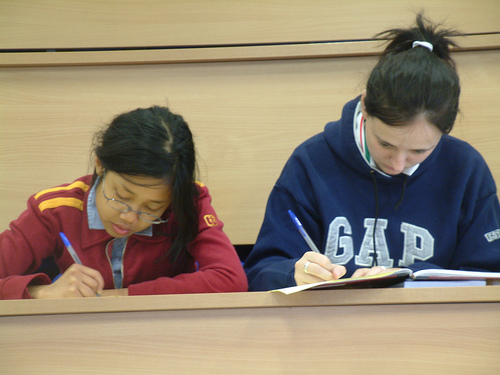
Photo provided under Creative Commons Licence by topgold via flickr


Recommended Reading

Harmer, J. How to Teach Writing, Pearson

Correcting Written Work

In a previous article, I talked about correcting workbook-type activities and suggested that students could be taught to self-correct effectively – thus saving the teacher’s time and promoting student autonomy. However, when it comes to freer written activities the situation is different – there is no single right answer and the text must be seen by the teacher. How can the text be marked most effectively ?

The aims of a marking method for open-ended written activities remains the same as before : to encourage the students to use the corrections as a tool for learning. This means helping them to “notice” what the errors are, to self-correct where possible, and to increase their understanding of areas that previously confused them.

To do this, try the following steps : proof-reading; guided self correction; comparison with a corrected version; follow-up work.

Step One : Proof Reading

If they are working on the computer, the students can, and should, be encouraged to use the spelling and grammar check. Suggest that they don't have this set to make automatic changes - which they may not even notice - but run the programme when they finish so that they also see the explanations. However, make sure they understand that the spelling and grammar programmes are not foolproof - they won't, for instance pick up on a mistake like We were in there garden - and that in any case they need to proof-read. Proof-reading does not mean reading the text through quickly immediately after it’s been written – you are too fixed on what you wanted to say, and simply don’t see the mistakes. It means leaving the text aside for a while, then looking at it again in detail – looking at every word and asking yourself questions about it. This can be taught to the students in class. After the first piece of work has been marked, ask students to analyse their errors. Ask for example how many people forgot the third person –s, forgot the plural –s, didn’t put the object immediately after the verb, forgot to use capitals for nationalities, etc. What you focus on will vary depending on the students’ level, their L1, and what you’ve been teaching recently. Write each type of mistake on the board plus the number of students who made it, to provide a ranking of the most common errors, and ask the students to copy the list down. Don’t make it too long. Explain to the students that from now on, you want them to look at their work again at least 24 hours after they’ve first written it, and look actively for two or three of those mistakes – the ones they know they make most frequently. At the end of the text they should note the date it was written, the date it was proof-read and the specific things they looked for.

Step Two : Guided Self-Correction


If you can, ask students to send you their work via E-mail.
Correct it by highlighting the errors and adding a code to indicate the type of mistake – for example Sp = spelling mistake; G = grammar mistake; VF = wrong verb form; Pu = punctuation; Pa = paragraphing; ^ = word missing; WW = wrong word.

The students will need a copy of the code – I usually cut and paste it at the top of their text before I send it back. Distinguish between errors and mistakes – a mistake is a slip, something the student knew but didn’t use correctly, while an error is something they don’t fully understand – either because they’ve misunderstood it or they’ve never met it before – and for which they need an explanation and practice activities. Put a number next to these errors.

By now, the text looks something like :

At 10 o’ clock I had a meeting with Mr. XXX, which(G-1) works for XXXX, the web agency responsible for the developing(WW) of ^ new website.(PA)
We discussed how upgrading(G-2) our database with the new content management system. At last(WW) we decided to use the old system for some (WW) months.

When they see this, the students’ first task is to look at the highlighted expressions and the code, and to try to self-correct, not bothering too much for the moment about the errors which have a number next to them. You may want them to do this before they see your corrected version, asking them to write their corrections on the text and bring it to the next lesson, when you’ll give them the “answers”. This is useful the first time, while you are teaching the students the method, but afterwards will depend on how much you “trust” them to do the work.

Step Three : Comparison with a Corrected Version

The next step is to produce a corrected version of their text, against which they can check their hypotheses. If they have tried to say something which is way above their current level of competence, you can simply rephrase it to show them how they could have expressed the same idea within the limits of the language they already know.

Step Four : Follow Up Work

At the end are the notes which relate to the errors, and which provide the students with a brief explanation and (possibly) a practice activity. If the students have a grammar book, this is one way that it can usefully be used. For example, if the students are using Murphy’s Essential Grammar in Use (CUP) the note might say : 1) "Who" is used for people and "which" for things. Look at Murphy Unit 112, paragraphs B and D only, and then do exercises 112.3 and 112.5.

You may also want to develop your own materials. This can be very time-consuming at first, but as long as you keep everything filed on computer, the activities can be used over and over again. They will build up even more quickly if you collaborate with other teachers in the school to build up a shared pool of resources. Quite a lot of the activities that you’ll see in the Language Snippets section come from the bank of the explanations/exercises which I’ve built up over time.

Time is, of course, the problem with this approach. If you have a lot of large classes you may not be able to work in this way all the time but will need to prioritise. You might want to give priority to students who have an important exam at the end of the year, or who are focusing specifically on writing skills. If your classes are smaller, you can organise the work so that only one or two classes are doing this type of writing each week, while the others are working on exercises which can be entirely self-corrected.

Should you correct every mistake?

What do you do with a piece of work which contains a large number of mistakes and errors? Will it be demotivating for the student if you indicate them all? Or will the student feel insecure if s/he knows that there are still uncorrected errors? Will the students be able to focus effectively on all the errors, or will the overload be counter-productive?

The answer to these questions will depend largely on the personality and motivation of the students, and whether they see your corrections as an evaluation (a product-based approach) or as a learning opportunity ( a process- based approach). The steps which I've outlined above are intended to encourage the latter, but also provide the possibility of a compromise between the two positions. If, on the original version, you indicate only those errors/mistakes which you feel the students will be able to focus on but in the corrected version provide extra changes, they are not faced with a demotivating mass of corrections, have a limited number of areas to focus on, but at the same time are not left with uncorrected errors which they might assume to be correct and later repeat.


Notes

Photo provided under Creative Commons Licence by Melisaur via flickr.